Politics
The DOJ Filed a Ballroom Brief That Reads Like a Truth Social Post
By Mike Harper · May 26, 2026
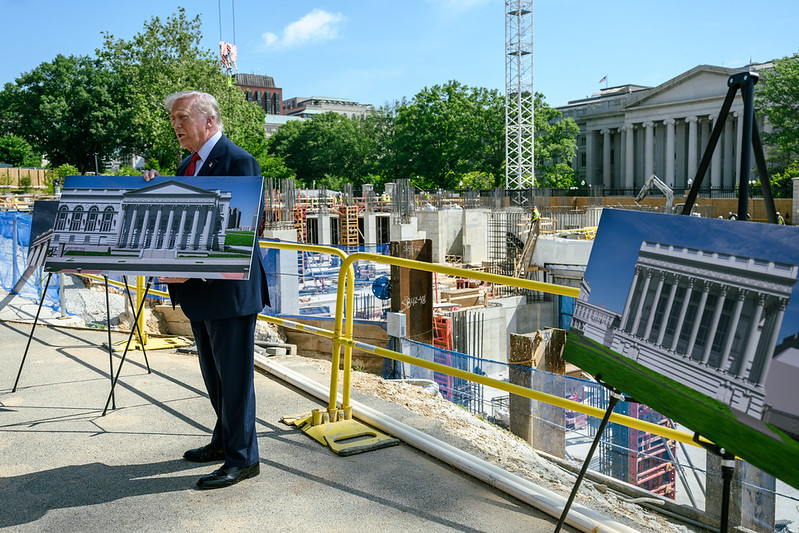
On Saturday evening, a man was shot and killed by Secret Service officers after opening fire at a White House checkpoint on Pennsylvania Avenue. By Sunday, the Department of Justice had filed a court document using that shooting as an argument for why a federal judge should allow construction of Trump’s White House ballroom to continue.
The filing, submitted by Acting Attorney General Todd Blanche to US District Judge Richard Leon, was unlike most documents produced by the Department of Justice.
It described their lawsuit as “frivolous” fourteen times.
It warned that continued litigation was jeopardizing national security by forcing the government to reveal classified construction details in court filings — and then immediately revealed those construction details in the same filing.
Those details: the completed White House ballroom complex will include drone deterrence systems, vantage points for rooftop snipers, bullet, ballistic, and blast-proof glass, impenetrable steel, missile-resistant columns, military-grade venting, and an underground bunker. It is, the DOJ argued, not a ballroom. It is a hardened security facility that happens to have a ballroom inside it.
Blanche wrote that the Saturday shooting “underscores the critical need for top level, state of the art security at the White House, including the Ballroom” — and that the $400 million project would allow Trump to “perform his constitutional duties in a safe and heavily secured facility.”
This is the second time the DOJ has cited a shooting near the White House in a court filing about the ballroom. The first came after the April 26 shooting at the White House Correspondents’ Dinner, which killed two people. Judge Leon rejected that argument. Now the DOJ is making it again, with a different shooting and the same conclusion.
The price of the project has undergone significant revision since Trump announced it. He initially estimated $200 million. He revised that to $400 million in December. The project now includes $1 billion in taxpayer funds sought through the Senate reconciliation bill — ostensibly for security rather than construction — bringing the total to $1.4 billion. Trump has continued to insist throughout that the ballroom itself is privately funded and that he is “making a gift” to the nation.
“All of this was paid for by myself. We are making a gift of this. This is a gift. This is not going to be paid for by the taxpayers,” he told reporters on May 19 while giving a tour of the construction site.
Judge Leon has not yet ruled on Sunday’s filing. He has previously expressed reservations about the project’s private financing arrangement and the lack of congressional authorization for construction of a permanent structure on federal land. An appeals court panel of three DC Circuit judges is scheduled to hear oral arguments on June 5 — the same week the Senate is expected to vote on the reconciliation bill containing the $1 billion security funding.
The project that began with Trump saying it would cost nothing from taxpayers now has a federal court filing, an appeals court date, a Senate funding provision, rooftop sniper positions, and a DOJ brief that includes the phrase “TRUMP DERANGEMENT SYNDROME” in capital letters.